Review. Endorse. Publish.
Advocates and suppliers put words, lessons, and claims before institutions.
Seen in 02 Editorial influence and 03 Curriculum suppliers
A connected investigation · 26 case files
From Einstein’s public image to textbook edits, curriculum campaigns, state appointments, and legislation.
Editorial poster detail. View the full poster
The connecting argument
Advocates and suppliers put words, lessons, and claims before institutions.
Seen in 02 Editorial influence and 03 Curriculum suppliers
Public bodies and publishers determine which proposals advance.
Seen in 04 Public authority and 05 Legislation
Final editions and classroom materials reveal what reached students.
Seen in Ector County’s later lessons and Texas’s required readings
The investigation began with the move from individual achievement to claims about a group. Its later records concern textbook advocacy, Christian Zionism, Bible instruction, and public authority. The connections are specific actions and overlapping roles—not shared identity alone.
Prestige
Einstein opens the question: how does a celebrated name acquire authority beyond its field? The bridge to textbooks is an ICS request to identify him as Jewish American in an existing passage.
One face. Many relationships. The portrait concentrates attention. The group photograph puts organizers and institutions back in view.
1919–1950 · Follow the record
Select a moment to see the event, the mechanism, and its limits.
10 case filesSwipe · tap to open
A discovery can change our understanding of nature. It does not make its author a superior human being—or give that person a greater claim on society’s priorities.
This essay examines the conversion of scientific recognition into public authority. Einstein is the case study: a scientist whose name became shorthand for intelligence, whose celebrity supported institutions, and whose political speech attracted both audiences and opposition.
Editorial position: evaluate ideas and institutions by their evidence, conduct, and consequences. Fame is not a measure of moral worth.
The question here is specific: how are the accomplishments of individual Jews used to support a narrative of collective intellectual superiority? And what happens when perceived intelligence is treated as evidence of virtue or a claim to authority?
Cultural historian Sander Gilman examines this move in his 2008 essay. He criticizes the use of individual achievements to naturalize racial categories and the linkage of intelligence with moral worth. His argument concerns the construction of a stereotype, not proof of an inherent group trait.
Read Gilman’s essay ↗Charles Murray’s 2007 “Jewish Genius” provides a concrete example of arguments connecting achievement, group intelligence, and heredity. It is an argument to examine, not an established explanation of achievement.
Read the argument under examination ↗These texts document a debate. They do not establish that Jewish people act as one institution or share a political purpose. This inquiry follows named participants and documented institutional outcomes.
The crucial move is from “these people accomplished something” to “this explains what their group is like.”
These cases examine identifiable authors and editorial choices. They document different kinds of claims, not a single coordinated campaign. Read the original argument alongside the analysis.
Choose prominent achievers or conventional measures of success.
Present separate accomplishments as a shared record.
Attribute outcomes to culture, inherited traits, or other proposed causes.
Publish, promote, and repeat the explanation through recognizable institutions.
Analytical model. Not every example makes every move. Claims about superior intelligence, cultural pride, and political entitlement must be identified separately.
Charles Murray · Commentary · April 2007
Murray’s essay moves from disproportionate representation in intellectual achievement to proposed explanations involving group intelligence and its origins. The object of analysis is explicit: a population-level explanation, built around selected accomplishments and measures.
This is a stronger example of an exceptionalism argument than a photograph of a famous scientist at a fundraiser. The claim is in the text itself. The publication identifies both the author making it and the platform distributing it.
Sander Gilman’s 2008 response examines the racial categories and the connection between intelligence and virtue in this debate. Read his critique ↗
Amy Chua & Jed Rubenfeld · Penguin Press · 2014
The book explains success among selected groups, including Jews, through three proposed traits: a superiority complex, insecurity, and impulse control. Its authors present these as cultural and psychological mechanisms rather than innate biological superiority. The argument includes several ethnic and religious groups, not Jews alone.
Yale Law School promoted the book through a news article identifying the authors’ professorships and emphasizing its research basis. This is a concrete example of an institutional platform presenting a broad social explanation associated with its faculty. A university announcement is not the same as independent validation.
Read Yale’s announcement ↗In 2016, researchers Joshua Hart and Christopher Chabris reported little support for the proposed combination in two surveys of nearly 1,300 adults. Their results challenge that formula; they do not settle every question about culture and achievement.
Example: My Jewish Learning · “Eight Famous Jewish Nobel Laureates”
A collection of Jewish Nobel laureates gathers people from separate fields into one communal account of achievement. This is an editorial act: identity becomes the organizing category, while the award supplies a shared mark of distinction.
That format can express historical interest or communal pride without asserting superiority. The additional leap occurs only when a writer treats the selected achievements as proof of an inherent group trait or a right to preferential treatment. Those claims must be found in the actual presentation, not inferred from the existence of the list.
These cases show narratives being assembled and circulated. To demonstrate a resulting hierarchy of legitimacy, the next evidence must concern decisions: a selection rule, funding criterion, appointment, exemption, or explicit claim that a group deserves greater authority.
The distinction makes the critique more precise. A claim about superior intelligence can be examined as a claim. A university’s publicity can be examined as publicity. An institution’s allocation of resources can be examined as an exercise of power. Connecting them requires a documented link.
Einstein’s celebrity illustrates access and institutional use. These complementary cases illustrate the construction and promotion of explanations about group achievement. Together they pose the question more clearly; they do not establish a common organizer or a shared intent among Jewish people.

A public image is produced through selection: whose face appears, whose name survives, and whose work becomes the background.
The familiar portrait makes a complex history look like a single person. Scientific work has authors, but it also has predecessors, collaborators, instruments, critics, publishers, and institutions. A portrait cannot show those relationships. A celebrity narrative can make them disappear from view.
The 1919 eclipse announcement supplied the decisive publicity event. Astronomers reported observations supporting general relativity at a meeting of two British scientific societies. Newspapers translated that result into a dramatic break with Newton. The story offered novelty, conflict, an authoritative announcement, and a central character.
That is the point at which specialist recognition and mass recognition diverge. Scientists can assess equations and observations. Most newspaper readers encounter the assessment through someone else’s authority. The public learns who is considered important before it learns enough to judge why.
Historical account and contemporary headlines · Max Planck Society ↗This is an editorial criticism of how prestige works, not an allegation that the eclipse results were invented. The question is what gets added to a scientific judgment when it becomes a cultural judgment about the person: intelligence in general, moral insight, political credibility, even a supposedly representative quality of a whole people.
Those added claims need their own evidence. A sound scientific result cannot do that work for them.
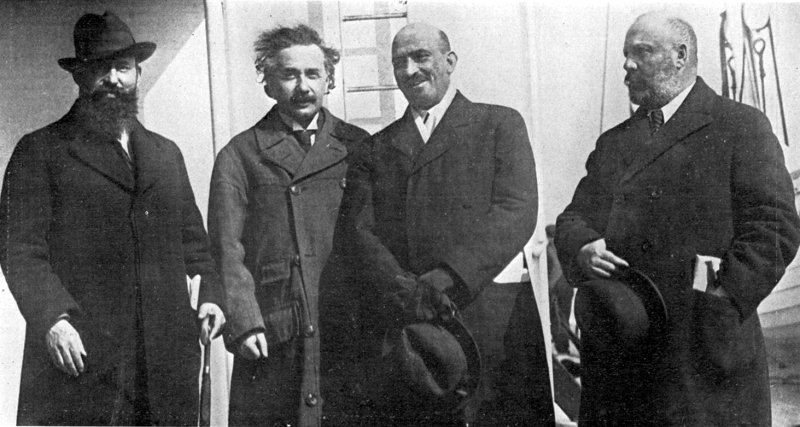
Photograph → affiliation
Correspondence → purpose
The group photograph is useful because it replaces the isolated genius with a social setting. Einstein is among organizers with an institution-building agenda. But the photograph alone cannot establish what each person intended. The correspondence provides the purpose: his American visit with Weizmann supported fundraising for Hebrew University.
Here the transfer of prestige is concrete. A scientific name helps draw an audience; an organized mission gives that audience a cause; fundraising seeks to turn attention into institutional resources. The university benefits from support that the celebrity helps attract.
This does not require relativity to have immediate commercial value. Attention itself is useful to an organization. A donor can associate a contribution with scientific achievement, cultural aspiration, or collective identity without evaluating the mathematics.
Read the correspondence volume’s editorial introduction ↗The critical question is what follows from that association. Supporting a university, expressing solidarity, claiming collective superiority, and demanding political privilege are distinct acts. An investigation should trace the transitions rather than assume that one automatically proves the next.
Physicists worried about uranium weapons wanted the president to listen. Einstein’s reputation and prior relationship with the Roosevelts made his signature useful. Alexander Sachs supplied another indispensable resource: access to Roosevelt.
The document illustrates a network of different contributions. Scientific information, drafting, endorsement, delivery, and executive action are not the same task. Treating the result as the accomplishment of one famous individual obscures how the intervention actually worked.
Roosevelt’s October reply reported a board to investigate the uranium proposal. The visible outcome was a governmental response—not a transfer of command to Einstein.
Roosevelt Library’s account ↗ · Read Roosevelt’s reply ↗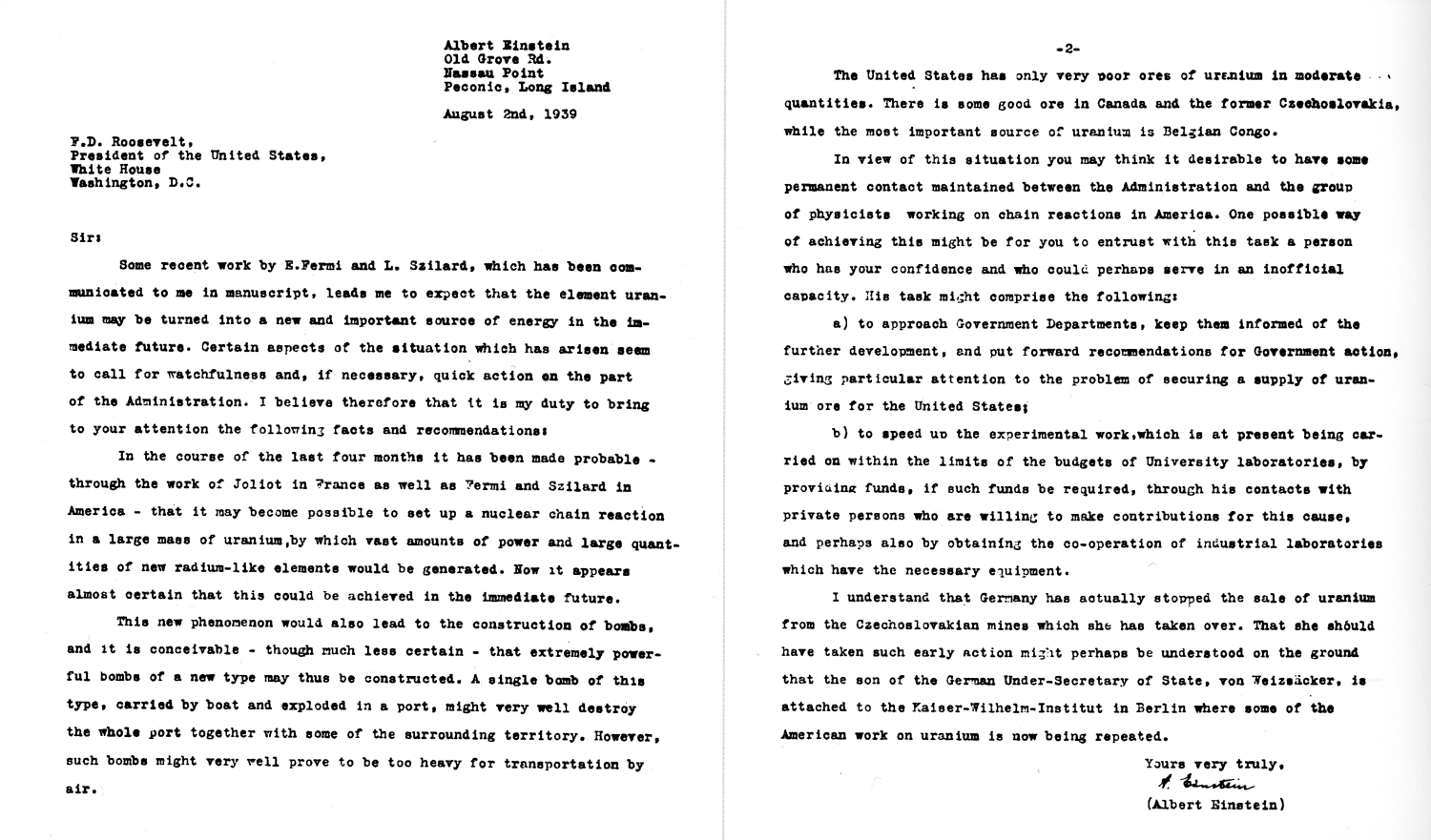
An institution’s legitimacy cannot be settled by what a prominent supporter says about himself.
The relevant record concerns what the supporter actually contributes: a signature, an appearance, a fundraising appeal, an introduction, or a role in governance. Each contribution can be examined without accepting the person’s account of his own motives.
For Einstein’s 1921 mission, the institutional destination was Hebrew University. The published correspondence documents the fundraising campaign and its political context. For the 1939 intervention, the route ran through other physicists and Alexander Sachs to Roosevelt, whose reply announced a board to investigate uranium. These examples show different ways a reputation can be put to work.
The larger question about exceptionalism is whether a specific use of prestige also advances a claim of collective superiority or preferential entitlement. That connection needs to be traced in the organization’s message, selection rules, and decisions. Institutional support and a superiority narrative are not interchangeable evidence.
The standard is the same for supporters and critics: identify the action, the beneficiary, and the consequence. Distinguish an outcome documented in the record from a consequence inferred from it. Accountability becomes stronger when responsibility is specific.
Fundraising record ↗ · Roosevelt’s documented response ↗Why should a famous equation place its author above a person who prevents suffering?
| Measure | What it asks | What it cannot establish |
|---|---|---|
| Scientific significance | Does the work improve explanation or prediction? | The author’s moral superiority. |
| Human welfare | Does it prevent suffering or improve people’s lives? | A monopoly on political judgment. |
| Institutional recognition | Who receives awards, posts, invitations, and resources? | That the distribution is fair. |
| Public visibility | Whose name reaches the largest audience? | Whose contribution matters most. |
A theory can be intellectually profound without being the most urgent social priority. A medical intervention can be indispensable without generating a celebrity. These are not contradictions. They show that attention and human benefit are different things.
The objection is to converting recognition into entitlement: a presumed right to be heard first, to receive deference outside one’s field, or to represent what intelligence itself looks like. The same standard applies whether the famous figure is a scientist, entrepreneur, writer, or political leader.
For the debate about Jewish exceptionalism, the additional leap is from selected individuals to a whole population. The achievements of a few people cannot assign intelligence, virtue, or political standing to everyone who shares an identity. Nor can criticizing those individuals justify assigning collective guilt.
The practical demand is accountable institutions. Examine who makes decisions, how access is allocated, what evidence is accepted, and whether the people affected can challenge an outcome. That turns a complaint about celebrity into an inquiry about power.
Scientific institutions give a claim standing within a field.
Reporting turns a technical result into a recognizable public story.
Organizers and intermediaries connect the famous person with donors and decision-makers.
Attention can become money, a meeting, or a place on the policy agenda.
Interpretive model drawn from the events above. Influence is not the same as control, and these steps are not inevitable.
There is no single ranking that makes conceptual novelty, lives saved, material benefit, and public fame interchangeable. A society can recognize a discovery without granting its discoverer greater human worth. The choice of whom to celebrate reveals cultural priorities as well as scientific judgments.
No. The concentration of credit and the extension of prestige beyond a field can be criticized independently of whether a particular result is correct. Allegations of theft require a separate comparison of dated papers, correspondence, and contributions.
Follow the observable contribution. The 1921 tour brought his celebrity into a fundraising campaign for Hebrew University. The 1939 letter put his signature and standing behind a warning delivered to Roosevelt by Alexander Sachs. These are identifiable uses of prestige, with named participants and institutional destinations.
The assessment should ask who organized the intervention, who received resources or access, and what decisions followed. A declaration of good intentions does not settle those questions. Neither does participation alone establish responsibility for every later action of an institution.
1921 correspondence and context ↗ · 1939 intervention and access ↗Specify an institution and a decision: who receives appointments, funding, admission, protection, or access? Compare the rules, outcomes, and relevant alternatives. A person’s identity alone cannot establish the mechanism. Named institutions and documented decisions make the question testable.
Once identity and achievement enter a textbook, the question becomes editorial: who proposes the wording, who accepts it, and where does it circulate?
Next 02 Editorial influence ↓Editorial influence
Follow requested wording into publisher responses, then into cross-edition requests, teacher preparation, and state-agency distribution.
U.S. public K–12 districts served, as reported in McGraw Hill’s 2025 prospectus. Not textbook market share or a count of students reached by an edit.
3 case filesSwipe · tap to open
A change negotiated with a major publisher can travel far beyond the room where it was agreed.
McGraw Hill’s 2025 SEC prospectus reported serving approximately 99% of U.S. public K–12 districts. That establishes a nationwide commercial footprint. It does not establish that every district used a particular book or that an edit reached every student.
The company’s 2026 annual report gives approximately 91%. The graphic retains its explicit 2025 attribution. Neither later figure measures the reach of the 2013 textbook changes discussed below.
2025 prospectus ↗ · 2026 annual report ↗This is the institutional issue: outside organizations can seek changes through a publisher whose products have broad reach. The evidence should identify the reviewer, the requested change, the publisher’s decision, and the editions affected.
Publisher reach is a reason to investigate editorial decisions closely. It is not evidence that one organization determines what 99% of children think.
A 2013 ICS submission in Tennessee’s education archive reproduces an exchange about textbook page 245. Einstein already appeared as an example of fame yielding power through the offer of Israel’s presidency. ICS requested identifying him as a Jewish American scientist, and called more generally for famous Jews’ origins to be acknowledged as group contributions.
The reproduced publisher response agrees, citing relevance to the presidential offer. ICS then requests national print and online implementation. This is documented identity-based emphasis and publisher agreement—not insertion of a previously absent Einstein, or independent confirmation of every final edition.
Tennessee archive · PDF page 130 ↗A separate 2013 submission requests deletion of the teacher-guide activity “Researching West Bank Settlements,” textbook page 585. ICS argues that the task is too complex for the allotted time and that available sources are polarized and disproportionately negative toward Israel. Those are the reviewer’s stated judgments.
The reproduced HMH response agrees to remove the activity from Georgia, Florida, other state editions, and national editions of its modern-world-history and full-survey texts. ICS requests national online and print implementation for Tennessee students.
An October 20, 2023 memorandum directs administrators to share educational resources with educators. It lists ICS classroom-discussion materials and its Arab–Israeli conflict curriculum for grades 6–12. It also lists other providers and explicitly makes the resources optional.
This establishes an official distribution channel. It does not establish mandatory use or exclusive control. The substantive issue is which perspectives the recommended materials contain and how educators use them.
Read the TEA memorandum ↗The evidence now moves beyond celebrity and publicity into editorial participation: identifying a celebrated person with a group, negotiating removal of a contested activity, and circulating teaching resources through a state agency.
These are distinct interventions with named actors. Their significance lies in what they add, remove, or make available to students. The Einstein edit documents collective recognition; the HMH exchange concerns political inquiry about Israel. Neither automatically establishes every broader claim about Jewish exceptionalism, and neither should be minimized as an insignificant wording dispute.
The institutional question is who can negotiate these decisions, how the decisions are reviewed, and how students’ opportunities to investigate are affected.
The editorial exchanges are individual cases. Organizational records describe the capacity behind them.
Organization-reported cumulative results and planned growth; not an independent audit of edits.
| Geographic activity | All 50 states |
|---|---|
| Educators and administrators trained | More than 18,000 |
| Textbook and state-standard edits | More than 14,000 |
| Team | 11 people |
| Financial scale | Described as a $2.8 million initiative |
| Three-year fundraising target | Nearly $10 million |
The brief dates strategic planning to 2022 and JCRC board approval to pursue independence to June 2023. It schedules independence for July 1, 2024 and tasks the incoming CEO with expanding staff, donor relationships, governance, and national visibility. These are explicit organizational objectives.
Read the recruitment brief · PDF pages 2–3 ↗JCRC Form 990, Part III, line 4a. The form is labeled 2021; its program narrative describes FY22.
| Training sessions | 154 |
|---|---|
| Unique social-studies educators | 1,843 |
| Program expenses | $1,259,153 |
| Reported K–12 policy changes | 196 concerning Judaism and Jewish history |
| Estimated students benefiting | 184,300 |
The student estimate multiplies 1,843 educators by an assumed 100 students per teacher. It is not an attendance count, a measure of actual classroom use, or evidence of changed student beliefs. The 196 policy changes and 14,000 cumulative edits also have different scopes and reporting periods.
Inspect the reproduced Form 990 ↗Hadassah’s June/July 2015 publication identifies Sandra Alfonsi as chair of Curriculum Watch, supported by 18 professors, historians, and attorneys. It describes engaging school systems, publishers, and communities over alleged bias and historical inaccuracies. These are the organization’s descriptions of its work.
Hadassah’s audited 2015 financial statements also describe nationwide member participation in Curriculum Watch. Alfonsi’s later PJTN and Moms for Liberty roles connect this review experience to a separate training platform. This establishes another organized participant in textbook advocacy. It does not establish shared command with ICS or a succession between the programs.
Hadassah’s 2015 program description ↗ · Audited financial statements ↗The structural issue is repeatable access: reviews, negotiations, cross-edition requests, and teacher preparation. Publisher distribution and outside advocacy are separate mechanisms that can reinforce each other. Their combined effect must be traced through specific content and implementation; the totals do not classify every change as ideological or demonstrate control of students’ thinking.
State standards, publisher review, and teacher preparation create several opportunities to shape classroom material.
PEI’s teacher guide dates its launch to 2009, jointly by Dallas’s Jewish Community Relations Council and ICS, before Texas reviewed its social-studies standards. It describes work with officials, publishers, curriculum writers, and teachers.
The guide expressly seeks recognition of Jewish contributions alongside accurate coverage of Jews, Judaism, and Israel. It pairs state standards with teaching questions and supplied answers. Its introduction says staff reviewed adopted standards and developed content around relevant teaching opportunities.
The guide describes a historical JCPA network of 125 community-relations councils and 14 national agencies. This is a network description, not a count of organizations directing textbook decisions.
PEI teacher guide · introduction and classroom examples ↗Texas’s January 29–30, 2014 State Board of Education committee minutes name Pat Epstein, representing PEI of the Jewish Federation of Greater Dallas, as a public witness on Proclamation 2015. The minutes establish participation in the instructional-materials process; they do not reproduce her testimony or establish that she caused a vote.
Official committee minutes · page 17 ↗These publications report organizational achievements without enumerating all the edits. The 2023 document also claims benefits for 2.1 million Texas students and purchases of Texas-produced materials by districts in 34 states; it supplies no underlying purchasing dataset.
Dallas Federation · 2013 annual report ↗The Texas Tribune’s March 11, 2010 report identifies Don McLeroy as the board member who successfully removed a reference to the continuing Palestinian–Israeli conflict and introduced language explaining conflict through Arab rejection of Israel.
Contemporary reporting · McLeroy’s amendments ↗| Standard | Instructional framing |
|---|---|
| 2010 · World History (13)(F) | “explain how Arab rejection of the State of Israel has led to ongoing conflict.” |
| 2018 revision · (13)(F) | Discuss contributing factors in the Arab–Israeli conflict, explicitly including rejection of Israel’s existence by the Arab League and most Arab nations. Paraphrase. |
TEA’s crosswalk records the change. The 2010 wording directs students toward a particular causal account. The 2018 revision opens the requirement to multiple factors while retaining rejection of Israel as an expressly named factor.
TEA · 2010–2018 World History comparison ↗The historical crosswalk was available in the search index; its original download returned 404 during this update. TEA also provides a later crosswalk showing the 2018 standards alongside the 2024–25 implementation.
Dallas JCRC’s 2023 publication explicitly includes mobilizing support for Israel in its mission. Its reported educational reach describes the organization’s own assessment of its work, rather than an independent measurement of students’ learning or beliefs.
Dallas JCRC · mission and reported results ↗September 2014 reporting describes education liaison Pat Epstein emailing board chair Barbara Cargill to oppose adoption of four McGraw-Hill books as written. The reported objections concerned portrayals of Israel and the weight given to Arab perspectives. This documents an attempt to obtain revisions through the adoption process; it does not establish the final disposition of each objection.
September 10, 2014 · reported email and objections ↗Contemporary JTA reporting quotes Jackie Berman saying an ad-hoc committee accepted 187 ICS edits and corrections. Susan Mogull supported reconsideration of Oxford’s previously rejected sixth-grade program after revisions. Oxford publisher Casper Grathwohl credited cooperation with ICS as central to returning the program for consideration.
The account also records Hindu and Sikh participation and disputes over religious representation. The episode illustrates a public adoption process in which organized reviewers could influence revisions and recommendations. It does not establish an exclusive channel for ICS.
JTA · November 11, 2005 ↗Jim Joseph Foundation’s grant ledger lists three awards for ICS initiatives, with a total of $1,060,740. Its stated purposes include expanding professional development on Judaism and the Arab–Israeli conflict.
| Award year | Amount awarded up to |
|---|---|
| 2010 | $60,740 |
| 2016 | $600,000 |
| 2019 | $400,000 |
| Total listed | $1,060,740 |
These records identify participation at several stages: proposing standards changes, reviewing publishers’ materials, developing aligned lessons, and training teachers. Funding can sustain and expand that work.
Evaluating the consequences requires examining the changes themselves: which facts were corrected, which identities emphasized, which perspectives added or removed, and how competing submissions were assessed.
Revising an established publisher’s material is one route. Producing and promoting a competing curriculum is another.
Next 03 Curriculum suppliers ↓Curriculum suppliers
Two Bible-curriculum suppliers competed for adoption. Publishing experience, endorsements, and legal advocacy helped promote their programs. Ector County shows what happened after selection—and replacement.
Conceptual book illustrations, not reproductions of published covers. The case records competing programs.
4 case filesSwipe · tap to open
Cullen Schippe brought senior textbook-publishing experience to a project that also supported research and advocated legislation.
Schippe was a retired Macmillan/McGraw-Hill vice president when The Bible and Its Influence launched in 2005. He co-edited the book with Chuck Stetson, the venture capitalist who chaired the Bible Literacy Project.
Contemporary reporting describes five years and approximately $2 million spent developing the book. Its publisher was BLP Publishing: this establishes an editorial-personnel connection, not a McGraw-Hill publication.
The project’s website reports use in 640 schools across 44 states and describes the program as a high-school elective.
This is the provider’s cumulative reach claim, not an independently audited count or evidence of mandatory nationwide adoption.
| Function | People and organization | Evidence described in the record |
|---|---|---|
| Produce the textbook | Cullen Schippe and Chuck Stetson, Bible Literacy Project | Co-edited The Bible and Its Influence. |
| Build the educational rationale | Bible Literacy Project / John Templeton Foundation | The project’s Bible Literacy Report explicitly identifies Templeton grant support. |
| Advocate legislation | Richard G. Scurry Jr., Bible Literacy Project | Texas’s April 3, 2007 witness record lists him supporting HB1287. |
These activities connect publishing, research, and legislative advocacy through the Bible Literacy Project.
Texas Freedom Network argued that Chisum’s original bill favored the National Council on Bible Curriculum in Public Schools by prescribing the Bible itself as the textbook, potentially excluding the Bible Literacy Project’s competing book.
That was TFN’s assessment of the proposal. It identifies competition between Bible-curriculum suppliers, which must be distinguished from a single coordinated operation.
Contemporary reporting on the 2005 launch of The Bible and Its Influence; the book’s editorial and publisher credits; the Bible Literacy Report grant acknowledgment; Texas’s April 3, 2007 HB1287 witness record; the Bible Literacy Project’s reported school reach; and Texas Freedom Network’s February 2007 assessment of Chisum’s original proposal. No direct links are listed for these references.
Daniel Lapin directly recommended a public-school curriculum to educators. A separate intervention by Paul Weyrich challenged a competing textbook on religious grounds.
In a May 10, 2010 letter, signed as president of the American Alliance of Jews and Christians, Lapin endorsed the National Council on Bible Curriculum in Public Schools’ curriculum. He praised its full semester on the Hebrew Bible and recommended it to school boards and teachers, offering further explanation on request.
This establishes active curriculum advocacy beyond appearing on an advisory list.
The letter presents ancient Israel’s arrival in the Promised Land and America’s settlement and founding as parallel projects built on biblical principles. Lapin argues that this makes the curriculum preparation for government, history, and civics courses.
The investigation interprets this as advocacy for a particular framework for American history alongside biblical literacy. The letter documents his rationale; it does not establish which classrooms adopted that interpretation.
A separate, undated endorsement on the curriculum provider’s website identifies Lapin as president of Toward Tradition. It commends both the organization’s educational mission and how it constructed its curriculum.
Together, the documents establish public support under both organizational affiliations. This extends the Toward Tradition connection noted in Johnson’s client relationships with a direct curriculum endorsement.
The provider republishes Paul Weyrich’s withdrawal of support for the competing Bible Literacy Project. Weyrich, identified as chairman and CEO of the Free Congress Foundation, credits Alabama Senator Scott Beason with changing his position.
His objections concern the textbook inviting questions about evil, suffering, Job, and God’s actions. He explicitly worries that students could lose their faith. That documents a religious criterion being applied to materials presented for public-school study.
This establishes Weyrich’s intervention, not Lapin’s participation in that particular campaign.
Lapin’s signed May 10, 2010 endorsement as president of the American Alliance of Jews and Christians; his undated Toward Tradition endorsement on the curriculum provider’s website; and the provider’s reproduction of Paul Weyrich’s May 29, 2008 withdrawal of support for the Bible Literacy Project. No direct links are listed for these references.
The Mike Johnson who promoted the NCBCPS course in Ector County later became Speaker of the U.S. House. His involvement included board membership, legal representation, and public promotion.
The identification is supported by his Louisiana legal biography and later reporting connecting Speaker Johnson to NCBCPS—not merely a matching name.
| Role | Evidence described in the record |
|---|---|
| NCBCPS board member and general counsel | Johnson’s published professional biography explicitly lists both positions. |
| Alliance Defense Fund attorney | Contemporary reporting identifies him simultaneously as an ADF attorney and NCBCPS board member. |
| Curriculum spokesman | He promoted the course in Ector County and publicly introduced its revised version in September 2005. |
In an August 2005 interview, Johnson argued that the program presented the Bible objectively and had undergone extensive review. Kathy Miller challenged both its sectarian content and the claimed scholarly vetting.
The transcript documents the curriculum provider’s representative personally defending those claims.
In 2005, Johnson explained that NCBCPS withheld its district list to protect participating schools from outside pressure.
The organization promoted broad adoption while preventing outsiders from readily checking which schools used its materials. Access to adoption records therefore matters separately from the organization’s claims about reach.
Johnson’s professional biography lists Toward Tradition, the organization associated with NCBCPS adviser Daniel Lapin, among the organizations he represented. It also lists Focus on the Family, the American Family Association, Concerned Women for America, and Coral Ridge Ministries.
These are documented client relationships. They do not establish that each client directed the curriculum.
Johnson’s published Louisiana legal biography; contemporary reporting on his ADF and NCBCPS roles; his August 2005 interview with Kathy Miller; September 2005 reporting on the revised curriculum; reporting on the withheld district list; later reporting identifying Speaker Johnson’s NCBCPS involvement; and his congressional biography. No direct links are listed for these references.
Following only the textbook contract would miss what continued through locally selected classroom materials.
In March 2005, Mike Johnson, who later became U.S. House Speaker, representing the National Council on Bible Curriculum in Public Schools, presented its course to the school board. Board president Randy Rives supported considering a Bible elective; superintendent Wendell Sollis oversaw the district’s response.
In December, the board voted 4–2 for NCBCPS materials over the competing Bible Literacy Project course. Rives cited a petition with more than 6,000 signatures and said he preferred NCBCPS because it used the Bible itself as the textbook.
The ACLU’s subsequent account says the district’s curriculum committee endorsed the Bible Literacy Project, but the superintendent submitted only NCBCPS for board approval. A contemporaneous Baptist publication also reported that the board selected NCBCPS despite the committee’s preference.
The superintendent-override detail comes from a party to the ensuing litigation.
Parents challenged the course, and the district agreed to replace it. The 2008 settlement required a seven-educator committee to develop an original curriculum. Trustees accepted the settlement 5–1–1; Rives voted against it.
The agreement allowed Bible instruction to continue under the replacement arrangement.
Examining 2011–12 materials, Mark Chancey found the following in Permian High School’s replacement course:
| Material or teaching approach | Chancey’s reported finding |
|---|---|
| Archaeology slideshow | Presented supposed archaeological evidence as confirmation of biblical miracle accounts. |
| Interpretation across the Testaments | Presented Christian readings treating Old Testament events as anticipations of the New Testament. |
| Creation lessons | Organized lessons around competing ways to reconcile Genesis with the natural world. |
These findings concern the later classroom materials, not merely the abandoned NCBCPS package.
Reporting on Ector County’s March and December 2005 adoption process; the ACLU’s account of the curriculum committee and district decision; contemporaneous Baptist reporting; the 2008 settlement and trustee vote; and Mark Chancey’s examination of Permian High School’s 2011–12 replacement-course materials. No direct links are listed for these references.
The next cases move from selling or endorsing materials to participating in the bodies that recommend standards and select textbooks.
Next 04 Public authority ↓Public authority
The record moves from outside objections into appointments and standards committees. Named roles show who could participate in decisions and how they invoked that authority.
The linked cases identify different roles and dates, not an automatic progression.
4 case filesSwipe · tap to open
Roy White connects a Texas textbook campaign with a later PJTN publication. The link is a named contributor, with documented activity at each date.
The Texas Tribune identified White as leader of Truth in Texas Textbooks and the Bexar County chapter of ACT! for America, founded by Brigitte Gabriel. His textbook coalition submitted a 469-page report shortly before adoption. He also proposed distributing ratings to school districts to exert purchasing pressure on publishers.
The agency extended publishers’ response deadline after late comments arrived. That procedural accommodation and White’s stated commercial strategy show two ways advocacy could reach publishers.
Texas Tribune · November 18, 2014 ↗Religious-studies scholar David Brockman’s 2016 Baker Institute report reproduces McGraw-Hill responses to the coalition’s objections. He criticizes the revisions as increasing religious imbalance.
| Material | Agreed revision, paraphrased |
|---|---|
| World geography | A passage about Islam’s spread became an account emphasizing attacking armies, conquest, and conversion. |
| World history | A passage permitting warfare as jihad expanded to describe duty, inward moral struggle, and historical armed struggle against nonbelievers and within Islam. |
These are documented revision agreements. Brockman notes that McGraw-Hill did not accept the full extent of the world-history reviewer’s demand.
Baker Institute report · printed page 13 ↗PJTN’s April 2024 white paper names Roy White as president and founder of Truth in Textbooks. Its contributor list also includes Sandra Alfonsi, Laurie Cardoza-Moore, Jennifer Dekel on behalf of EMET, Keith Flaugh, Michael Goldstein, M. Zuhdi Jasser, Shmuel Katz, Daniel Piedra, Hal Rounds, William Saxton, and Stanley G. Tate.
This is an explicit publication credit, establishing collaboration on that document. It does not establish that every contributor directed the others’ organizations or earlier campaigns.
PJTN white paper · contributor list, page 14 ↗PJTN calls itself an Evangelical Christian Zionist organization in its May 2024 release. In June, Cardoza Moore described writing about Jewish contributions to America and U.S.–Israel ties to sustain future generations’ commitment to Israel. The organization also requested government investigations of publishers over content it characterized as antisemitic.
These statements connect educational representation to a stated political objective. Assessing that work requires examining its actual lessons, proposed revisions, and outcomes.
PJTN · May 2024 self-description ↗ · PJTN · June 2024 educational objectives ↗The connection now reaches a formal state role: PJTN’s founder serves on the body that recommends Tennessee’s textbook list.
A December 11, 2025 letter signed by House Speaker Cameron Sexton reappoints Laurie Cardoza-Moore to the State Textbook and Instructional Materials Quality Commission, with her term ending June 30, 2028. The letter is printed in the January 13, 2026 House Journal, page 2753.
House Journal · reappointment letter ↗The commission recommends an official list to the State Board of Education. Following state approval, local boards select district materials. Membership gives Cardoza-Moore a formal role in collective recommendations; it is not unilateral textbook-selection authority.
Tennessee · commission responsibilities ↗Moms for Liberty’s July 22, 2024 national online training listing names Cardoza-Moore and Sandra Alfonsi together. It identifies Alfonsi as PJTN’s textbook and education adviser, former director of National Hadassah’s Curriculum Watch, and former chair of Hadassah’s Academic Advisory Board.
The listing documents personnel continuity and a shared training platform. It establishes a specific collaboration between named participants, without establishing common governance of their organizations.
Moms for Liberty · event and speaker biographies ↗In a March 2014 essay, Cardoza-Moore described a parent’s concern that classroom material had led her son to question biblical claims concerning Israel’s homeland. She connected that complaint to her campaign against Pearson’s The Cultural Landscape.
Her account identifies Nashville Jewish Federation executive director Mark Freedman as supporting removal and describes her testimony before Tennessee legislators. This is evidence of the rationale and support she publicly claimed, not independent validation of her allegations about the textbook.
Cardoza-Moore’s essay · reproduced March 25, 2014 ↗| Decision maker | Recorded outcome |
|---|---|
| Local review and school board | Reporting says the review committee found the book not biased and the county school board denied the removal appeal. |
| Publisher | Later reporting states Pearson removed the disputed suicide-bomber question from subsequent editions. |
A failed local removal campaign and a subsequent publisher revision are separate outcomes. Neither outcome alone establishes the correctness of every accusation made during the campaign.
ALA bulletin · reporting on the local review and appeal ↗ · 2017 reporting · publisher revision ↗A legislative sponsor helped redistribute appointment authority—and later served on the resulting commission alongside a textbook campaigner.
Senator Mike Bell introduced SB1602; Representative Glen Casada sponsored its House companion, HB2249. Dolores Gresham was a Senate co-sponsor. Governor Bill Haslam signed the legislation on May 22, 2014. It became Public Chapter 981, effective January 1, 2015.
The earlier statute establishes the original arrangement. Tennessee’s comptroller documents the restructuring and says legislators cited complaints about textbook bias and inaccuracies as reasons for expanding participation.
| Before | After restructuring |
|---|---|
| The governor appointed nine commission members. | Appointment authority was divided equally among the governor, House speaker, and Senate speaker. |
| Existing members occupied their seats. | Existing membership was removed, requiring appointments or reappointments. |
| Public participation was less formally defined. | Additional opportunities for public review and parental input were established. |
Tennessee’s official roster lists Mike Bell as the East Tennessee public member for July 2022–June 2025, appointed by the lieutenant governor. It lists Laurie Cardoza Moore alongside him as the Middle Tennessee public member, appointed by the House speaker. Reporting from a November 2022 meeting independently confirms Bell’s commission service.
The sequence connects legislative sponsorship with later membership in the institution whose appointment rules changed. It does not establish that Cardoza Moore wrote or directed the 2014 law.
The 2020 comptroller evaluation found that the commission had delegated reviewer recruitment and appointment to the Department of Education. It also found that the commission traditionally approved the reviewers’ successful textbook list without discussion, while considering publisher appeals.
At a 2022 meeting, Cardoza Moore wanted the commission to define age-appropriate materials. Bell pushed back, saying its statutory task was to issue guidance. Their shared institutional position did not mean identical decisions.
This adds appointment rules and delegated review work to the investigation. The practical question is how authority moves between legislators, appointing officials, reviewers, and the commission itself.
SB1602 and HB2249; Public Chapter 981 (2014); the earlier Tennessee commission statute; Tennessee comptroller documentation and its 2020 evaluation; the official commission roster for July 2022–June 2025; and reporting on the November 2022 commission meeting. No direct links are listed for these references.
The same advocate participated in standards recommendations, held a textbook-review seat, and cited that seat while demanding changes to school materials concerning Israel.
Tennessee’s official roster names Laurie Cardoza Moore, appointed by Cameron Sexton, on its Social Studies Standards Recommendation Committee. The resulting standards received final approval in February 2024 and take effect in 2027–28.
Committee chair Katherine Shultz and vice-chair Ashley Flood were district content specialists. The roster establishes Cardoza Moore’s participation; it does not identify which individual revisions she authored.
Tennessee describes the implementation sequence explicitly:
Participation at the standards stage can influence the requirements publishers must satisfy later.
In an April 4 press release, PJTN demanded removal of materials associated with Ramadan events at Houston High School and Houston Middle School. Cardoza Moore spoke as PJTN’s president while invoking her commission membership and state compliance requirements.
| Actor | Action described in PJTN’s account |
|---|---|
| Todd Starnes | Publicized the initial allegations, according to PJTN. |
| Cardoza Moore / PJTN | Called for removal of materials and warned administrators about liability under state law. |
| School principals and a Jewish Federation | Cardoza Moore said she contacted them seeking the materials distributed to staff. |
| Cameron Sexton | She explicitly invoked his appointment of her to the textbook commission when explaining her intervention. |
The release labeled the materials pro-Hamas and argued that responsibility for hunger rested with Hamas. Those are PJTN’s allegations; the reproduced sentence itself does not endorse Hamas.
This documents the use of public office to support an advocacy demand. The release reports that administrators had not responded by publication. It supplies no commission vote, removal order, or confirmed withdrawal of materials.
Tennessee’s Social Studies Standards Recommendation Committee roster; the state’s standards approval and implementation materials; and PJTN’s April 4, 2024 press release concerning Houston High School and Houston Middle School in Germantown. No direct links are listed for these references.
Appointments allocate seats. Statutes, interpretations, and standards determine what those institutions can require.
Next 05 Legislation & implementation ↓Legislation & implementation
Statutes and interpretations can create requirements. Model policies can circulate without passing. The Texas, Tennessee, and Florida cases keep those outcomes distinct.
4 case filesSwipe · tap to open
Ken Paxton helped enact the statute whose separate curriculum provision his office later used to support required religious-literature instruction.
Texas’s legislative record identifies Warren Chisum as HB1287’s principal author, Craig Estes as its Senate sponsor, and Ken Paxton among its coauthors. Rob Eissler, then House Public Education Committee chair, was a joint author.
The enacted bill contained two distinct provisions. The second was present from the beginning and became the basis of the 2025 interpretation.
| Provision | What it established |
|---|---|
| Section 1 | Authorized elective Bible courses for students in grade nine and above, with neutrality requirements and teacher training. |
| Section 3 | Added religious literature—including the Old and New Testaments and their influence on history and literature—to the enrichment component of the required K–12 curriculum. |
Rob Eissler and Scott Hochberg submitted an argument that the legislature intended an independent elective. Paxton’s opinion rejected that reading and distinguished optional standalone courses from the separate curricular requirement. Follow the opinion into the board’s later standards decision.
The disagreement therefore involved a joint author of the original legislation. Paxton’s office relied on Section 3 to support required instruction integrated into other subjects.
The House Research Organization’s 2007 analysis lists the following participants, among others.
| Supporter | Organization |
|---|---|
| Jonathan Saenz | Free Market Foundation |
| Julie Drenner | Texans for Family Values |
| Richard Ford | Heritage Alliance |
| Richard G. Scurry Jr. | Bible Literacy Project |
| Opponent | Representation identified |
|---|---|
| Mark Chancey | Named in opposition |
| Kathy Miller | Texas Freedom Network |
| Paul Colbert | Anti-Defamation League |
| Jan Soifer | Austin Jewish community organizations |
These are documented positions on this bill, not evidence of a unified religious bloc.
Texas HB1287’s 2007 legislative record and enacted text; the House Research Organization’s 2007 bill analysis and hearing participants; Eissler and Hochberg’s October 2025 submission; and Attorney General Opinion KP-0503. No direct links are listed for these references.
A board chair requests an interpretation, the attorney general supplies it, and the board cites it in adopting standards.
Both proposals Pickren was scheduled to present at NACL also appear in ALEC’s model-policy catalog: the Religious Literature and Its Impact Act and the Informed American Patriotism Act. ALEC lists both as finalized on August 12, 2026.
This establishes their availability through a second legislative distribution network. The records reviewed do not identify who transferred or authored them.
The model expressly requires non-devotional instruction and prohibits compelling religious belief. Its mechanism is curricular inclusion supported by standards, materials, and training.
| Date | Actor | Action described in the record |
|---|---|---|
| October 9, 2025 | Aaron Kinsey, State Board of Education chair | Asked Attorney General Ken Paxton whether religious-literature standards were mandatory and could be embedded in other subjects. |
| November 17, 2025 | Paxton’s office | Issued Opinion KP-0503, concluding that the board must establish those standards and districts must provide compliant instruction. It endorsed integration into other courses as an available method. |
| June 2026 adoption; August publication | Texas State Board of Education | Adopted revised English-language-arts standards and cited the opinion when rejecting requests to remove required religious texts. |
The first two steps are recorded in the opinion itself; the third is documented in the Texas Register.
Two former representatives argued that the legislature intended an independent elective, rather than religious literature embedded in other courses. Paxton’s opinion rejected that interpretation. The board subsequently used the opinion to defend required readings against public objections.
This identifies the institutional steps between interpreting a statute and setting classroom requirements. It also records disagreement over the authority claimed for those requirements.
ALEC’s catalog entries for the Religious Literature and Its Impact Act and the Informed American Patriotism Act, both listed as finalized August 12, 2026; Texas Attorney General Opinion KP-0503; and the Texas Register’s August 2026 publication of the revised English-language-arts standards and responses to public comments. No direct links are listed for these references.
An organization circulates model language, advocates promote it, legislators enact it, and state institutions must adjust covered publications.
The National Association of Christian Lawmakers, led by Jason Rapert, supplied a model bill prohibiting “West Bank” in official state materials and replacing it with “Judea and Samaria.” Its document identifies the Committee on America–Israel Relations and Alabama Representative Mark Gidley alongside the proposal.
Governor Bill Lee signed Tennessee’s Public Chapter 877 on April 27, 2026, with an effective date of July 1. Chris Todd and Paul Rose were its primary House and Senate sponsors.
The measure brings terminology advocacy into binding policy for covered government publications.
| Actor | Role identified in the record |
|---|---|
| Jason Rapert / NACL | Promoted the model legislation across states. |
| Yossi Dagan | The Shomron Regional Council leader advocated recognition of “Judea and Samaria” among American conservative lawmakers. |
| Mark Pody | The Tennessee senator said a visit to Israel with Mike Huckabee inspired his support for similar legislation. |
| Laurie Cardoza Moore / PJTN | PJTN reports that she testified supporting the bill’s historical and biblical rationale. |
| Chris Todd / Paul Rose | Primary House and Senate sponsors of the Tennessee legislation. |
| Bill Lee | Signed the measure on April 27, 2026. |
Public Chapter 877 declares that the modern return of Jewish people to these territories fulfills biblical prophecies, citing Jeremiah, Ezekiel, and Amos. It also presents support for sovereignty there as affirming the Bible’s authenticity.
These are declarations made by the legislature, not historical conclusions endorsed by this website. Their relevance here is institutional: biblical interpretation appears in the rationale for a binding government language policy.
The act prohibits the terminology in official state-agency materials and state-funded creation of those materials. It expressly includes administrative course descriptions, catalogs, and institutional publications.
The act exempts public-university faculty lectures, classroom remarks, research, and other expressive academic work. Although Pody told the Forward that textbooks were included, the records reviewed do not establish a resulting McGraw-Hill textbook revision.
NACL’s model legislation and Committee on America–Israel Relations document; Tennessee Public Chapter 877 and legislative records; PJTN’s account of Cardoza Moore’s testimony; and reporting in the Forward including Pody’s explanation of his involvement. No direct links are listed for these references.
Florida legislators advanced an explicit school-materials terminology mandate. A sitting Texas curriculum decision-maker also held a leadership role in NACL’s model-legislation network.
CS/HB 31 would have required district and charter-school materials adopted or acquired from July 1, 2026 onward to use “Judea and Samaria” and prohibited “West Bank.” Its scope expressly included instructional materials and school libraries.
Chase Tramont and Debra Tendrich sponsored the House measure. Ralph Massullo sponsored the similar Senate bill.
| Date | Step |
|---|---|
| January 20, 2026 | Tramont’s amendment added explicit instructional-materials and school-library provisions. |
| January 21 | The amendment was adopted. |
| February 11 | The House passed the bill, 92–14. |
| March 13 | Both measures died in Senate Rules. |
Texas’s official biography identifies Julie Pickren as a State Board of Education member and member of its Ad Hoc Committee on Social Studies. NACL identifies her as chair of its Committee on International Relations.
These are overlapping institutional roles documented by the organizations themselves. NACL’s October 31–November 1, 2025 meeting agenda also schedules Pickren to present education proposals.
| Committee | Leadership | Scheduled presentation |
|---|---|---|
| America–Israel Relations | Lana Theis, chair; Mark Gidley, vice-chair | Gideon Israel, Jerusalem Washington Center president: Judea and Samaria sovereignty model act. |
| Education | Ted Alexander, chair; Gary Click, vice-chair | Julie Pickren: Informed American Patriotism Act and Religious Literature and Its Impact Act. |
The agenda establishes planned policy work and named responsibilities. It does not establish that every proposal passed.
NACL describes working committees developing model legislation for introduction elsewhere. Its website reports 51 model laws, 41 state chairs, and members or supporters nationwide. These figures are the organization’s own accounting.
A national religious policy organization includes a sitting Texas curriculum decision-maker in its leadership, schedules her to present education proposals, and promotes territorial terminology through model legislation. Florida legislators separately advanced a school-materials mandate using that terminology.
The records reviewed do not establish that NACL supplied Florida’s school-specific amendment or that McGraw-Hill changed a book because of it.
Florida CS/HB 31, Tramont’s January 20 amendment and legislative action records; the similar Senate measure; Texas’s official Julie Pickren biography; NACL’s committee leadership listings and October 31–November 1, 2025 meeting agenda; and NACL’s description and reported figures for its model-legislation program. No direct links are listed for these references.
The final test is implementation: which editions changed, which lessons were taught, and which decisions can be traced to a named participant?
Next What connects to what ↓Relationship index
These are different kinds of relationships. A client relationship, an endorsement, an appointment, and an enacted rule carry different consequences.
Reading the cases together
Editorial review, training, supplier selection, appointments, and rulemaking can each affect educational material. Ownership of a publisher is only one possible source of authority.
The cases identify those transitions through employment, governance, contributor credits, and public appointments. Each connection has its own date and scope.
Ector County makes classroom implementation central. The distinction between promised revisions, printed editions, and actual lessons remains essential throughout.
Florida’s terminology proposal failed. Suppliers competed. Bell and Cardoza Moore disagreed over the commission’s task. The 2007 Bible bill drew opposition from both secular and Jewish organizations. These outcomes belong inside the account of institutional power.
The remaining work is concrete: locate the full list of reported TEKS edits, compare final editions, trace commission votes, and inspect the materials teachers actually used. Those records determine the reach and consequences of a particular intervention.
Reader’s index
26 case files
The case files contain two forms of source material: direct links retained from earlier research, and later research summaries naming records without URLs. Both are organized here by case. This editorial reorganization adds no new research or source verification.
Contemporary reporting on the 2005 launch of The Bible and Its Influence; the book’s editorial and publisher credits; the Bible Literacy Report grant acknowledgment; Texas’s April 3, 2007 HB1287 witness record; the Bible Literacy Project’s reported school reach; and Texas Freedom Network’s February 2007 assessment of Chisum’s original proposal. No direct links are listed for these references.
Open case file ↗Lapin’s signed May 10, 2010 endorsement as president of the American Alliance of Jews and Christians; his undated Toward Tradition endorsement on the curriculum provider’s website; and the provider’s reproduction of Paul Weyrich’s May 29, 2008 withdrawal of support for the Bible Literacy Project. No direct links are listed for these references.
Open case file ↗Johnson’s published Louisiana legal biography; contemporary reporting on his ADF and NCBCPS roles; his August 2005 interview with Kathy Miller; September 2005 reporting on the revised curriculum; reporting on the withheld district list; later reporting identifying Speaker Johnson’s NCBCPS involvement; and his congressional biography. No direct links are listed for these references.
Open case file ↗Reporting on Ector County’s March and December 2005 adoption process; the ACLU’s account of the curriculum committee and district decision; contemporaneous Baptist reporting; the 2008 settlement and trustee vote; and Mark Chancey’s examination of Permian High School’s 2011–12 replacement-course materials. No direct links are listed for these references.
Open case file ↗SB1602 and HB2249; Public Chapter 981 (2014); the earlier Tennessee commission statute; Tennessee comptroller documentation and its 2020 evaluation; the official commission roster for July 2022–June 2025; and reporting on the November 2022 commission meeting. No direct links are listed for these references.
Open case file ↗Tennessee’s Social Studies Standards Recommendation Committee roster; the state’s standards approval and implementation materials; and PJTN’s April 4, 2024 press release concerning Houston High School and Houston Middle School in Germantown. No direct links are listed for these references.
Open case file ↗Texas HB1287’s 2007 legislative record and enacted text; the House Research Organization’s 2007 bill analysis and hearing participants; Eissler and Hochberg’s October 2025 submission; and Attorney General Opinion KP-0503. No direct links are listed for these references.
Open case file ↗ALEC’s catalog entries for the Religious Literature and Its Impact Act and the Informed American Patriotism Act, both listed as finalized August 12, 2026; Texas Attorney General Opinion KP-0503; and the Texas Register’s August 2026 publication of the revised English-language-arts standards and responses to public comments. No direct links are listed for these references.
Open case file ↗NACL’s model legislation and Committee on America–Israel Relations document; Tennessee Public Chapter 877 and legislative records; PJTN’s account of Cardoza Moore’s testimony; and reporting in the Forward including Pody’s explanation of his involvement. No direct links are listed for these references.
Open case file ↗Florida CS/HB 31, Tramont’s January 20 amendment and legislative action records; the similar Senate measure; Texas’s official Julie Pickren biography; NACL’s committee leadership listings and October 31–November 1, 2025 meeting agenda; and NACL’s description and reported figures for its model-legislation program. No direct links are listed for these references.
Open case file ↗The reporter, the teacher, the record and the check. Voices generated with Fish Audio.
Who shapes what we learn?
The reporterThere is a poster that asks it in red capitals. Who controls the page? I want the answer. One name, one desk, one pencil.
The teacherI teach social studies. I want something smaller. When a sentence reaches my students, I want to know who put it there.
The checkThen we follow the sentence, not a face. Three steps. Someone proposes the wording. Someone decides whether it advances. And then it is printed, trained and taught, or it is not.
The recordPropose: review, endorse, publish. Decide: appoint, select, legislate. Implement: print, train, teach. Every case on this page sits somewhere on that line.
The reporterAnd it starts with Einstein. Why Einstein?
The recordBecause the investigation began with a move from one person's achievement to a claim about a group. Its later records concern textbook advocacy, Christian Zionism, Bible instruction, and public authority.
The checkAnd the rule holds from the first case to the last. The connections are specific actions and overlapping roles. Not shared identity alone.
The teacherSo, five chapters. Prestige, editorial influence, curriculum suppliers, public authority, and legislation. Let us start where the fame starts.
01 · Prestige
The reporterNineteen nineteen. An eclipse, a meeting of two British scientific societies, and the newspapers announce a break with Newton. A man becomes a symbol overnight.
The recordAstronomers reported observations supporting general relativity. Newspapers translated that into novelty, conflict, an authoritative announcement, and a central character.
The checkThis is a criticism of how prestige works, not an allegation that the eclipse results were invented. The public learns who is considered important before it learns enough to judge why.
The teacherThen the portrait does something the photograph of the group does not.
The recordNew York, nineteen twenty-one. Einstein with Zionist leaders, among them Chaim Weizmann. The correspondence gives the purpose: fundraising for Hebrew University. A famous name draws an audience, a mission gives the audience a cause.
The reporterAnd in nineteen thirty-nine the name reaches the president.
The recordThe August second letter, signed by Einstein and largely drafted by Leo Szilard. Alexander Sachs supplied access to Roosevelt. Roosevelt's October reply reported a board to investigate uranium.
The checkA governmental response. Not a transfer of command to Einstein. Scientific information, drafting, endorsement, delivery, and executive action are different tasks.
The teacherWhere does the group come in?
The recordIn arguments the page examines by name. Charles Murray's two thousand seven essay, Jewish Genius, advances a theory of group intellectual advantage. Sander Gilman's two thousand eight response criticizes using individual achievements to naturalize racial categories.
The checkAn individual's achievement cannot establish a group's superiority. These texts document a debate. They do not establish that Jewish people act as one institution or share a political purpose.
The reporterThen what would establish structural advantage?
The checkA decision. Name an institution, and ask who receives appointments, funding, admission, or access, and under what rule. Identity alone cannot do that work.
The teacherAnd once identity and achievement enter a textbook, the question becomes editorial. Who proposes the wording, who accepts it, and where does it circulate?
02 · Editorial influence
The reporterNinety-nine percent. That is the number on the poster. One company, ninety-nine percent of public school districts.
The recordMcGraw Hill's twenty twenty-five prospectus reported serving approximately ninety-nine percent of U.S. public K to twelve districts. The twenty twenty-six annual report gives approximately ninety-one.
The checkDistricts served. Not textbook market share, and not a count of students reached by any edit. Reach is a reason to examine editorial decisions closely. It is not evidence that one organization decides what children think.
The teacherSo show me an edit.
The recordTwenty thirteen. A submission from the Institute for Curriculum Services, preserved in Tennessee's education archive, about page two hundred forty-five of a Glencoe textbook. Einstein already appeared there. The Institute asked that he be identified as a Jewish American scientist. The reproduced publisher response agrees.
The checkDocumented identity-based emphasis, and publisher agreement. Not the insertion of an absent Einstein, and not independent confirmation of every final edition.
The recordA separate twenty thirteen submission asked Houghton Mifflin Harcourt to delete a teacher-guide activity: Researching West Bank Settlements. The reproduced response agrees to remove it from Georgia, Florida, other state editions, and national editions.
The teacherA whole classroom investigation, taken out across editions, in more than one state.
The reporterHow big is the operation behind this?
The recordThe Institute's twenty twenty-four recruitment brief reports more than eighteen thousand educators trained and more than fourteen thousand textbook and state-standard edits, across all fifty states, with a team of eleven.
The checkThose are the organization's own cumulative figures, not an audit. The narrower annual form reports one hundred ninety-six policy changes. Different scopes, different periods.
The teacherAnd in Texas the state agency itself sent the materials around.
The recordAn October twentieth, twenty twenty-three memorandum from the Texas Education Agency lists the Institute's classroom materials among other providers, and makes them optional.
The checkAn official distribution channel. Not mandatory use, and not exclusive control. Revising a publisher's book is one route. Producing a competing curriculum is another.
03 · Curriculum suppliers
The reporterTwo Bible courses walk into a school board.
The recordThe Bible Literacy Project's book, The Bible and Its Influence, launched in two thousand five. Its co-editor, Cullen Schippe, was a retired Macmillan McGraw-Hill vice president. The competitor was the National Council on Bible Curriculum in Public Schools, which used the Bible itself as the textbook.
The checkAn editorial-personnel connection, not a McGraw-Hill publication. And competition between suppliers, which is not one coordinated operation.
The teacherWho stood behind the second course?
The recordDaniel Lapin signed a May tenth, twenty ten letter recommending it to school boards and teachers. Mike Johnson, who later became Speaker of the U.S. House, is listed in his own professional biography as its board member and general counsel. Contemporary reporting identifies him at the same time as an Alliance Defense Fund attorney.
The reporterThe future Speaker of the House pitched a Bible course to a Texas school board?
The checkHe promoted it. In March two thousand five he presented it to the Ector County school board. That is the documented role. Board membership, counsel, and public promotion.
The recordIn December the board voted four to two for his organization's materials. The ACLU later said the district's curriculum committee had preferred the competing course.
The checkThat detail comes from a party to the litigation that followed. Keep it attributed.
The teacherAnd then parents sued.
The recordThe twenty oh eight settlement replaced the course with one developed by a seven-educator committee. Trustees accepted the settlement. Board president Randy Rives voted against it.
The teacherSo it was fixed.
The recordExamining twenty eleven and twenty twelve materials, Mark Chancey found an archaeology slideshow presenting supposed evidence as confirmation of biblical miracles, and creation lessons built around reconciling Genesis with the natural world.
The checkThe board changed the official curriculum. Locally chosen slides, worksheets and teaching practice carried on. The classroom is its own part of the record.
04 · Public authority
The checkThere are two kinds of influence here. Asking for a change. And helping decide one.
The reporterStart with the asking.
The recordTwenty fourteen, Texas. Roy White led Truth in Texas Textbooks. His coalition submitted a four hundred sixty-nine page report shortly before adoption, and he proposed distributing ratings to districts to put purchasing pressure on publishers.
The recordA twenty sixteen Baker Institute report reproduces McGraw-Hill's agreed revisions. One passage on Islam's spread became an account emphasizing attacking armies, conquest and conversion.
The checkDocumented revision agreements. The report also notes McGraw-Hill did not accept the full extent of the reviewer's demand.
The teacherAnd the deciding?
The recordTennessee. A December eleventh, twenty twenty-five letter from House Speaker Cameron Sexton reappoints Laurie Cardoza-Moore, the founder of PJTN, to the State Textbook and Instructional Materials Quality Commission, through June twenty twenty-eight.
The checkThe commission recommends a list to the State Board. Local boards then choose. A formal role in collective recommendations. Not unilateral textbook selection.
The reporterWho decided who gets to sit there?
The recordIn twenty fourteen Senator Mike Bell introduced the bill that divided appointment power among the governor and both speakers, and removed the existing members. From twenty twenty-two to twenty twenty-five, the official roster lists Bell himself as a commission member.
The teacherHe rewrote who picks the selectors, then became one.
The checkThat sequence is documented. And at a twenty twenty-two meeting, Bell pushed back on Cardoza Moore about the commission's task. A shared seat did not mean identical decisions.
The recordOn April fourth, twenty twenty-four, a PJTN release demanded removal of Ramadan-related materials at two Germantown schools. Cardoza Moore spoke as PJTN's president and invoked her commission membership.
The checkThe use of an official title to support an advocacy demand. The release reports no commission vote and no confirmed withdrawal of materials.
05 · Legislation and implementation
The teacherThis is the chapter I worry about. The one where a proposal becomes something I am required to teach.
The recordTexas, two thousand seven. House Bill twelve eighty-seven. Its principal author was Warren Chisum, and Ken Paxton was among its coauthors. It had two provisions. One authorized elective Bible courses. A separate one added religious literature to the enrichment curriculum for every grade.
The reporterAnd eighteen years later Paxton is attorney general.
The recordOn November seventeenth, twenty twenty-five, his office issued an opinion concluding that the board must establish religious-literature standards and that districts must provide compliant instruction, including through other subjects.
The checkA joint author of the original bill, Rob Eissler, argued the legislature meant an independent elective. The opinion rejected that reading. The disagreement is part of the record.
The recordIn June twenty twenty-six the State Board adopted revised English standards and cited the opinion when rejecting requests to remove required religious texts.
The teacherText. Interpretation. Requirement. No new Bible-course law needed.
The reporterTennessee went further, didn't it?
The recordPublic Chapter eight seventy-seven, signed April twenty-seventh, twenty twenty-six, replaces West Bank with Judea and Samaria in official state materials. Its text declares a fulfillment of biblical prophecy. Model language came from the National Association of Christian Lawmakers.
The checkThose are the legislature's declarations, not conclusions this page endorses. And the records reviewed do not establish a resulting McGraw-Hill textbook revision.
The recordFlorida's version passed the House ninety-two to fourteen on February eleventh, twenty twenty-six. Both measures died in Senate Rules on March thirteenth.
The checkNot every proposal becomes a requirement. A failed bill belongs in the account of power as much as a passed one.
The teacherSo the final test is my classroom. Which editions changed, which lessons were taught, and which decision traces to a name.
What connects to what
The reporterPut it on one board for me. Who connects to whom?
The checkEleven connections, and they are not the same kind of thing. A client relationship, an endorsement, an appointment, and an enacted rule carry different consequences.
The recordEinstein, the Institute for Curriculum Services, and McGraw-Hill: identity emphasis in an identifiable edit. Schippe and the Bible Literacy Project: professional experience. Johnson and his council: overlapping roles. Lapin: endorsement.
The recordWhite and PJTN: collaboration across time, dated twenty fourteen and twenty twenty-four. Sexton and Cardoza Moore: an appointment. Bell: legislation, then membership. Paxton: a statute, then its interpretation.
The teacherTap one, and it takes me to the case.
The checkThat is the point of the index. Each line is a door into the record, not a conclusion about everyone in the room.
Follow authority to the lesson
The recordThree conclusions the structure supports. Influence has several entry points: review, training, supplier selection, appointments, rulemaking. Ownership of a publisher is only one.
The checkPeople carry expertise and access between institutions, through employment, governance, contributor credits, and appointments. Each with its own date and scope.
The teacherAnd an official decision is not the end of the chain. Ector County proves that. Promised revisions, printed editions, and the lessons actually taught are three different things.
The reporterI came in wanting one name behind the desk on that poster.
The checkAnd you got many names, each attached to a decision. Florida's proposal failed. Suppliers competed. Two commissioners disagreed. The two thousand seven Bible bill drew opposition from secular and Jewish organizations.
The reporterThen the poster's question was the wrong one. It is not who controls the page. It is who made this decision, and who can challenge it.
The teacherPrestige, expertise, faith, and public office each carry authority. The point is to make their use visible, and open to scrutiny.
The recordEvery source for this is listed at the end of the page, and every one of them is linked.
The checkIf something here is wrong, it is wrong in the record, and we would want to know. The corrections address is in the footer.
The teacherThis was The Authority of Genius. A Feline Union publication.
Circulate
Each card is one finding that stands on its own. Every post links back to the full investigation.


